Destinations / The Best Places to Visit in New Jersey, U.S.A. / Jersey City
Jersey City
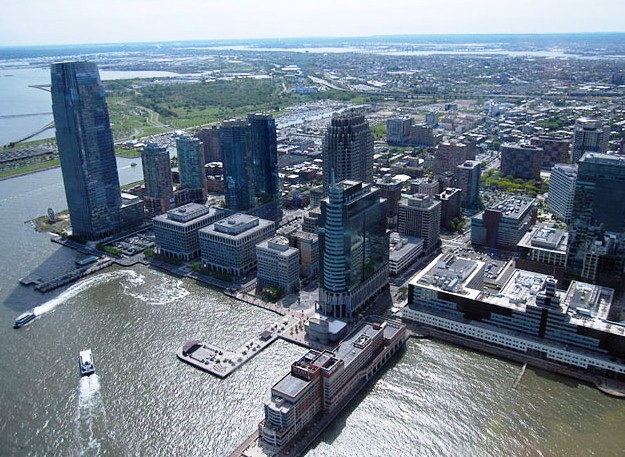
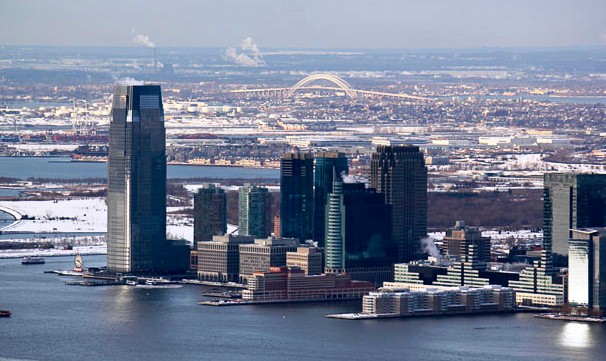
Jersey City is the second largest city in the state of New Jersey with a population of 247,000 people ( 2010). The city is bordered by New York and it is often regarded as one of the suburbs of Greater New York. Jersey City is located on a peninsula, separated from Manhattan by the Hudson River . In the north, Jersey City is bordered by the city of Hoboken , in the east by the Hudson River and Manhattan, in the south by the city of Bayonne and the Hackensack River in the west. In the southern part of the town on the border with Bayonne is a deep-water port, which is part of the Port of New York.
Jersey City once was known as an industrial and transportation center. It was a city dominated by brown and gray color. From factory chimneys smoke poured. A third of land was owned by a railway and trains rumbled night and day. In the 1960s, the railroad went bankrupt, piers rotted and the factories closed. Hard times started and the population of Jersey City began to decline. Positive changes began in 1990, with the transformation of the waterfront. In the place of factories and depots were erected tall buildings for different purposes (hotels, office buildings, residential apartments).
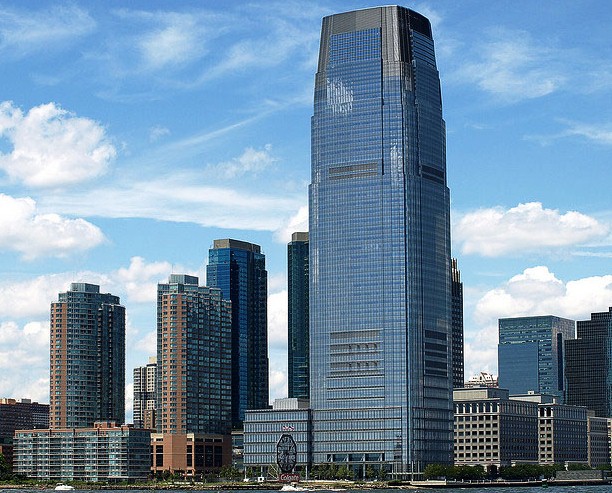
Today, more than them fill the office space tenants, attracted by lower prices and proximity to Manhattan. In the financial business district of Jersey City, which is known as Exchange Place, settled companies such as Citygroup, Merrill Lynch, UBS, Goldman Sachs, Chase Bank. The construction of tall buildings right at the Hudson did not stop till today. The tallest skyscraper in Jersey City is the Tower Goldman Sachs, with a height of 238 meters. Despite its relatively small size, the city consists of different neighborhoods, different from each other. Most of the buildings are concentrated in the Hudson River. Other areas of the city are neighborhoods 2.5 storey houses.
40% of households in Jersey City do not have a car, this is partly due to the well-developed public transport, which is used by 46% of the population (one of the highest in the country). You have access to Manhattan in a few minutes. A ferry service was also established. There is a car connection with Manhattan via the Holland Tunnel, laid under the Hudson River. There is also a high-speed subway Port Authority Trans-Hudson, connecting Newark - Jersey City - Manhattan. Tunnels, which go to the compositions are laid under the Hudson River. In the Jersey City buses and trams speed.
As in New York, the population of Jersey City is a patchwork mix of nationalities and cultures. Part of the population to have European roots (Italians, Poles, Irish). Others came from the Arab countries, Africa, Asia, and India. In addition, there are many immigrants from Cuba, the Philippines, Puerto Rico, the Dominican Republic. There is a significant Jewish community. 37% of Jersey City were born outside the United States. It is 3 times higher than the average values of the U.S. (12% of Americans born abroad), but comparable with the statistics of New York (35%). The survivor of renaissance, Jersey City has a good reputation. It is closer to Manhattan than parts of the Manhattan.
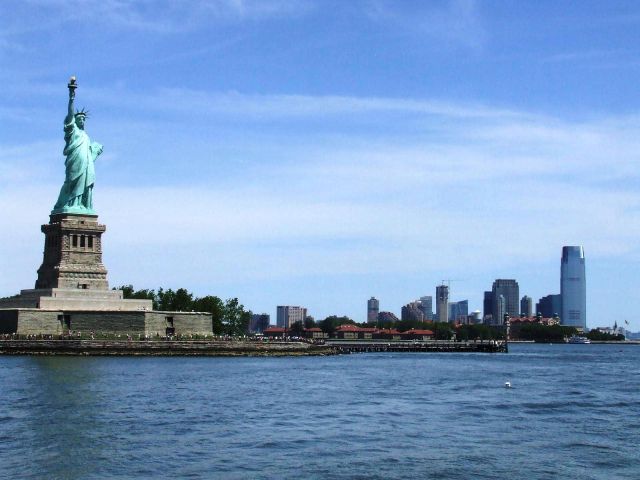
In this case, Jersey City is much more a quiet and a peaceful place, there are fewer people, tourists. Most people visit the Ellis Island and the Statue of Liberty , are sent there from Battery Park in Manhattan. However, you can get there by ferry departing from the docks of Jersey City. Ellis Island and the Statue of Liberty are located directly opposite the park area, called the Liberty State Park . In the northern part of the park is Central Railroad of New Jersey Terminal, from where ferries go . Deep in the Liberty State Park is a modern Science Museum Liberty Science Center. Downtown is the business district of Jersey City interesting in itself. It includes part of the embankment, which offers great views of Manhattan. The basis of downtown are the Exchange Place and Newport.
Others from The Best Places to Visit in New Jersey, U.S.A.

When it began to turn in business, in the noise of the big cities, tall skyscrapers, the anthill of the cars and people sometimes forgot that once at the same location was a different life.
Hundreds of years ago, long before the arrival of the Europeans on the grounds of what is New Jersey now, sometimes peacefully and sometimes not so quiet and very peaceful lived Indians.
A little hunting, then a little fighting.
Their descendants are known as the Delaware and Munsee Indians spread across North America.
The largest group of these Indians now live near Bartlesville, Oklahoma.
After the discovery of America by Columbus, the first who explored the coast of New Jersey, was the Italian explorer Giovanni da Verrazano.
It was already in 1524.
In 1609 for research purposes Hudson arrived, and the 1638-m founded the first colony.
The colony was founded by the Swedes.
This colony was located on the river Delaware.
In 1660, the Dutch founded the city.
How do you think it was called? It was the Dutch, then the city they called simply - Bergen.
Today this city exists, but is called Jersey City.
The British, who until then, apparently, did other things, came in 1664 in New Jersey and took control of the city of Bergen.
Maybe this is when it was renamed Jersey City.
The British did not always behave consistently.
Initially (in 1676), they shared New Jersey to East Jersey and West Jersey.
And then (in 1702), they have something went wrong, and they put two colonies back into one.
In 1721, there was one village, founded by William Trent .
In fact, it was, of course, a village.
But Trent village was named "Trent's Town".
No wonder they say, "How do you call a boat, so it will float.
" As a result, the village of Trent really grew into a city.
And even in 1790, became the capital of the state.
This town is now called Trenton .
In the eighteenth century in America the pace of growth and change became too amazing.
In 1721 they founded the village.
And in 1746 in New Jersey, was founded the first university the Princeton University.
For a while Princeton was the capital of New Jersey.
During the war for independence, for a period from 1776 to 1783 years, in New Jersey occurred over a hundred battles.
For this staff even came to be called "The Crossroads of the Revolution".
New Jersey became the third state, which came into the United States.
It happened on December 18, 1787.
The flag of New Jersey was orange with the coat of arms in the middle.
Two women on the arms represent freedom and fertility.
Written on the tape making independence year - 1776.
The flag of the state was officially adopted in 1896.
In 1876, Thomas Edison opens up the laboratory in Menlo Park, and in 1879 invented the incandescent lamp (in New Jersey, and now have priority high technology - 11% of the funds going to the U.
S.
for research is spent in New Jersey).
In 1883, Roselle was the first American city, which was lit by electricity.
World War II involved more than half a million people in New Jersey.
The state built battleships, heavy cruisers, aircraft engines and other military hardware.
The first line in New Jersey was built in 1951.
The first ski jump in 1963.
In 1978, in Atlantic City were legalized gambling, and opened its first casino.
Atlantic City - one of these sites attract crowds of people who cannot wait to give their money to someone.
Now New Jersey is one of the most economically developed states of America.
By volume of the gross domestic product is second only to staff large and populous states.
For example, such as New York, Texas, California while giving them the size of the territory.
In New Jersey, besides a well-developed network of roads and railways, there are twelve airports, two seaports.
The most developed industries are those chemical and electrical.
The large state income also bring financial sector and tourism (legal gambling are felt).
In the farm all standard - growing vegetables, fruit, nuts.
The largest cities in New Jersey: Newark , Jersey City , Paterson, Hamilton, Trenton and others.
Atlantic City is a resort and tourist city known around the world.
The territory of New Jersey is 7419 square miles of land and 1,303 square miles of water, total - 8722 square miles.
The state's population - 8.
5 million people.
Northwest States is not full with very high mountains, and in the rest, the terrain is mostly flat.
The climate in New Jersey is warm.
In January, the temperature roughly around zero (Celsius) and in July of about 30 degrees Celsius.
• Area of New Jersey - 22 608 km 2 (47 in the U.
S.
) • The length of the State of New Jersey: o from the north to the south - 240 km o from the east to the west - 110 km • Region of New Jersey - Mid-Atlantic U.
S.
• Area of New Jersey - 22 608 km 2 (47 in the U.
S.
) • The length of the State of New Jersey: o from the north to the south - 240 km o from the east to the west - 110 km • Region of New Jersey - Mid-Atlantic U.
S.
• The highest point in the state of New Jersey - 550 meters above sea level • The lowest point in the state of New Jersey - 0 meters above sea level • Abbreviation of the state of New Jersey - NJ • The capital of the State of New Jersey - Trenton • The largest city in New Jersey - Newark • Date of establishment of the State of New Jersey - December 18, 1787 (3 in U.
S.
) • The population of New Jersey - about 8.
8 million people (11 in the U.
S.
) • The population density in the state of New Jersey - 460 people per km 2 (1 in U.
S.
) • The motto of the State of New Jersey - "Liberty and Prosperity" The nickname of New Jersey - " "The State of gardens", "Crossroads of the revolution" New Jersey got its name from the British island of Jersey, the largest of the Channel Islands, located in the English Channel.
Symbols of the State of New Jersey Violet - a symbol of the State of New Jersey • Tree New Jersey - red oak (Quercus rubra) • Flower of New Jersey - violet sister (Viola sororia) • Berry, New Jersey - tall blueberry • Animal of New Jersey - domestic horses (Equus ferus caballus) • Bird of New Jersey - American Goldfinch (Carduelis tristis) • Fish of New Jersey - American trout (lake char) (Salvelinus fontinalis) • Insect of New Jersey - honey bee (Apis mellifera) • Colors of New Jersey - yellow and blue
Images of Jersey City, icons, photos, figures, visions, appearances, illustrations, snapshots, captures, canvas and pictures of Jersey City - The Best Places to Visit in New Jersey, U.S.A.