Destinations / The Best Places to Visit in Calabria, Italy / Gerace
Gerace
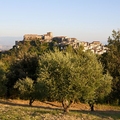
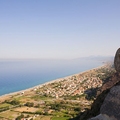
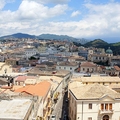
Gerace is a medieval town in Calabria ( the province of Reggio Calabria ), part of the club, "The most beautiful towns in Italy . " Gerace is located at an altitude of 1,500 feet above the sea level, overlooking the picturesque city of neighborhoods. Gerace was founded in the V century BC by the Greeks who had fled from Locri who destroyed the Saracens. According to the legend, the place of founding of the city had a hawk - Ierax in Greek which gave the name of the city.
Hawk emblem adorns the city. In Byzantine times it became the capital of the region Gerace. In the X century a citadel which reflects the many defenders attack of the Arabs was built. But in the end Gerace fell into the hands of Arabs, though not for long. After the City won the Norman Robert Guiscard warrior, Gerace again became Byzantine. At this time the city was rich and prosperous. On its territory 79 churches were housed and only a few survived till now. Gerace was also one of the most fortified cities in the south of Italy , at the highest point of the city was built a magnificent castle. In Gerace was one memorable occasion. The two famous brothers, Robert and Roger Normans had a disagreement with the separation of the Calabrian earth. Gerace believed their ruler Roger, though the Greeks were loyal to Robert. In the midst of a dispute, Robert besieged his favorite Roger Millet, Roger slipped out of the town and got to Gerace seeking reinforcements. But Robert ran after him and was furious when the city gates shut in his face. Robert still managed to get into Gerace, a hood covering his face. But, unfortunately, the servant of Robert, Basil found him and betrayed him. Robert Guiscard immediately seized and Basil and his wife were killed. In spite of the quarrel, the brothers loved and respected each other and did not want to cause harm. Therefore, the area outside the gates of the city was the place for the meeting of the two brothers, they hugged each other and resolved the conflict. And the area is still called piazza del Tocco - the contact area. Gerace remained Byzantine until late Middle Ages. Then Gerace was ruled by Shvebsk and Anjou dynasties. In the XIX century Gerace was part of Italy .
What to See in Gerace
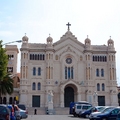
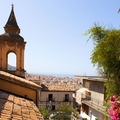
Like all the southern cities of Italy, Gerace was often subjected to earthquakes, however, many old buildings have survived and the center of the city preserved the spirit of the medieval, narrow streets, palaces and churches. In the XV century in Gerace were about 100 churches, now there are far fewer of them: the Cathedral in Norman-Gothic style is the largest church in Calabria (the size of 75 m in length and 25 m in width). The Cathedral was consecrated twice in 1045 and 1222 in the presence of Frederick II. The Council consists of two parts: the crypt and the upper basilica. The Greco-Byzantine crypt is the oldest part of the cathedral, the crypt was originally in the form of a "T", but later were added to two chapels. The upper church is a huge building, divided into three naves 20 columns. In the cathedral were kept many ancient treasures: the crucifixion of the XII century. It is decorated with sapphires and emeralds, according to the legend, a gift of Roger II, a silver pitcher of the XVII century and a statue of the Virgin Mary and Child XIV century. From the Cathedral Square with easy access to the Three Churches (Piazza delle Tre Chiese), which in line with the title, are three churches: The church of San Francesco (Chiesa di San Francesco) is one of the most important and significant churches of southern Italy . The church was built in the late XIII - XIV centuries. This is quite a simple form of construction in the Gothic style. Worthy of attention is the Baroque altar and the lancet arch of triumph of the inlaid marble (1664). The church is the sarcophagus of Fulk Ruffo of Calabria (1374). The church of San Francesco is adjacent to the Monastery of San Giovanni Crisostomo. Now here is a small museum. Another church in the area is the Byzantine Church of San Giovannelli (Chiesetta di San Giovannello). A small single nave church of stone and brick, dating from the X-XI centuries and erected in X century is the convent of San Giovanni Crisostomo. It is a typical example of Byzantine architecture. The church was decorated with frescoes, from which only traces now remained. The church of San Martino (Chiesa di San Martino) was built in 1783 on the site of an ancient Byzantine church, which was damaged in an earthquake. Near the church is a small Byzantine necropolis. Well preserved is the Byzantine church Nundziatella (Chiesa della Nunziatella), also called the church of San Teodoro. It is a small cross in the building. Within a nave and two small niches you can see traces of Byzantine frescoes. Near the church was a monastery, but after an earthquake in 1783 the monastery was completely destroyed and the church suffered in part. Another Byzantine Church of San Nicolas del Cofino (Chiesa di San Nicola del Cofino). During the archaeological excavations there have revealed tombs and medieval coins dating from the XV-XVI centuries.
In addition, there are a number of churches in Gerace since the XVIII and XIX centuries:
The Church of Santa Maria del Mastro (Chiesa di Santa Maria del Mastro) (XVIII c.).
The Church of Santa Maria di Montserrat (Chiesa di Santa Maria di Monserrato) (XVII c.), which stores an ancient wooden statue of Madonna.
The Church of St. Catherine (Chiesa di Santa Caterina).
The Church of San Martino (Chiesa di San Martino) was built in 1783 on the site of an ancient Byzantine church, which was damaged by an earthquake. Near the church is a small Byzantine necropolis.
Others from The Best Places to Visit in Calabria, Italy
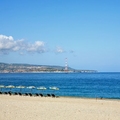

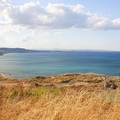
The poet Gabriele d'Annunzio called the seafront in the town of Reggio di Calabria, "the most beautiful kilometer in Italy".
Underdeveloped industry and the lack of big cities for a long time, left the sea not polluted and Calabria is still considered a natural paradise.
Reggio Calabria, situated on the shore of the strait between Italy and Sicily is the largest and the oldest city in Calabria, numbering 3,000 years of history .
Here are the Botanical Gardens, the National Museum of Magna Grecia and the Aragonese Castle.
Also on the shores of both the Tyrrhenian and Ionian seas there are a number of smaller but picturesque cities with beautiful attractions.
In Tropez is the Santa Maria dell' Izola.
Siderno is known for its comfortable hotels.
Gerace attracts visitors for the Norman castle and its old cathedral.
Skuillache is a beach resort and a place of archaeological sites.
Style is home to the famous philosopher and the utopian Tommaso Campanella, the Norman castle and a Byzantine church.
The main resorts in Calabria are Tropea, Soverato and Scalea.
Resorts in Italy: Calabria (Tyrrhenian Sea) The ancient, harsh land with a rich history, Calabria in the 40-ies of the XX century was practically empty.
Most of the residents had left their native land and went to seek their fortune in northern Italy, America, Canada and Australia.
Italy's entry into the EU initiated the revival of Calabria.
And today, this is a very popular tourist destination.
Best time to visit is from June till September.
Calabrian coast is washed by two seas: the Ionian and the Tyrrhenian.
It has enough beaches for every taste: you can spend time in deserted hidden bays among rocks or hang out in crowded, well-equipped beaches, in the evening transformed into noisy discos.
The beaches on the Tyrrhenian coast are sandy, rather long, surrounded by small cliffs.
Ionian coast is solitary, small and rocky.
Besides the usual beach activities and water sports, you can do "historical adventure" diving.
Fans have the opportunity to examine the remains of 50 sunken ships off the coast, some of which relate to the IV century BC.
The Gioia Tauro It is a 3-mile sandy beach with small patches of gravel.
If you have sensitive feet, it is better to walk on the beach in flip-flops.
There are several bars, restaurants and showers on the territory.
Near the beach there are a few parking lots.
This is a rare beach not closed by rocks, so there is always a refreshing sea breeze blowing.
The Lipari Islands and the Cape of Capo Vaticano are visible from the shore of the island when the weather is fine .
The water is very pure.
The beach is not too crowded and very convenient for families.
Palmi Just as the Gioia Tauro, the Palmi beach is sandy and full with pebbles, sometimes not very pleasant when barefeeted.
The length of the beach is 1 km, the width 50 meters.
In summer it is literally dammed up people.
Free parking cars cannot contain all comers.
Palmi is surrounded by cliffs and approached by coast mountains, overlapping access to the wind, so the hot season here is too hot.
Tropea The beautiful sandy beach is included in the top 10 beaches in Italy of 2004.
It has fine, soft sand.
The length of the beach is of 500 meters, the width is of 30 meters.
During the season it is difficult to park nearby.
The coastal cliff overlooks the beach breeze from the sea.
The Capo Vaticano This is a 500-meter-long beach covered with soft clean sand.
Also, as Tropea, it is very crowded, not enough parking spaces.
Here come a couple and single holidaymakers, hoping to meet new people.
There are bars, restaurants, showers on the territory.
Scilla The classic sandy beach stretches for kilometers along the aquamarine waters.
Scilla is surrounded by cliffs, so here are extremely rare refreshing winds.
To escape from the heat, the sea or a few local bars can only be a solution.
On clear days you can see the coast of Sicily from here.
Reggio di Calabria This is a new bulk beach sand which was brought to the Gioia Tauro.
Rather narrow (25 meters), it stretches for kilometers and it is not too crowded.
The beach is opened to the breeze in bars, restaurants, showers, there are places for free parking.
Soverato The picturesque fishing village of Soverato is stretched by snow-white sandy beaches for a kilometer.
Here there is are "civilized" areas with bars, restaurants, lounges and showers, as well as more secluded corners where you can admire the sunset in the sea with an "intimate" setting.
Scenic views stretch along the beach promenade.
Plan to find housing? If we calculate the average prices for hotels, Reggio Calabria preserves an ancient Italian city.
This point is located in the southwest area of Calabria ( Reggio di Calabria ), at a distance of about 120 km from the town of Catanzaro .
Reggio Calabria is one in the far west of the city in the region.
This ancient city has a long and a rich history.
Obviously, the most important tourist attraction it is the Museo Nazionale Della Magna Grecia.
The Mediterranean Sea for tourists, of course, is a strong argument to choose the purpose of travel.
The number of inhabitants is about 180,000 people.
Reggio Calabria is an important port city.
From the terminal Metromare you can get to other interesting places on the Mediterranean cities, it appears that the Reggio Calabria is one of the five most expensive cities in the region.
Currently, the city can offer its customers a number of hotels and resorts.
Famous areas of the city are : Ravagnese , Pentimele , Archi and Gallico .
The reservation of the rooms is better done in advance.
Reggio Calabria Cheap hotels and accommodation in the district To navigate, you can see other cities in the vicinity.
Table of reference prices for accommodation in selected cities (average price per person per night).
Reggio Calabria and leisure opportunities Are you looking for ancient monuments? Milazzo Castle belongs to the most interesting objects.
Here you will be able to expand your knowledge of history.
Castello Ruffo Recreation and Relaxation Spiaggia di Scilla refers to such places in the county that can make your vacation unforgettable.
Enjoy water fun for your pleasure.
And if you look at the map, nearby you will still find other places perfectly suited for swimming.
Spiaggia di Scilla Reggio Calabria - Transport Removed from the City, the Airport Reggio Calabria (REG) at 4.
3 km: the road will take you only a few minutes of steam.
These constants are flying airlines, for example, from these points: International Airlines Reggio Calabria Airport.
What services do you provide here? If it happens that you get tired, take a break and will find for itself a cafe.
A nice little holiday will not hurt for sure ! Park your car and you will get no problems.
Services in the city and surrounding areas Reggio Calabria - rent, car rental, vehicle rental services Sure, it makes sense to rent a car, because everywhere in the district there are a number of places where you can go.
And what's more, so you save time.
Arrange in advance online a booking car.
Very often it comes money is more profitable than a service purchased on the spot.
Here you can see prices.
What is the best time to visit? This place is situated in the temperate zone.
The weather is usually very pleasant, with no large jumps in temperature.
Images of Gerace, icons, photos, figures, visions, appearances, illustrations, snapshots, captures, canvas and pictures of Gerace - The Best Places to Visit in Calabria, Italy