Destinations / The Longest Rivers in the World / The Amur River
The Amur River
About the Amur river
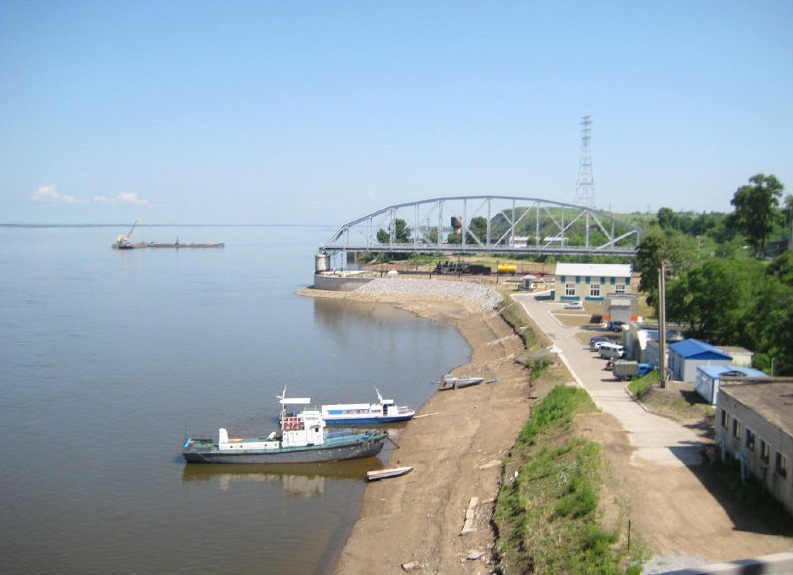
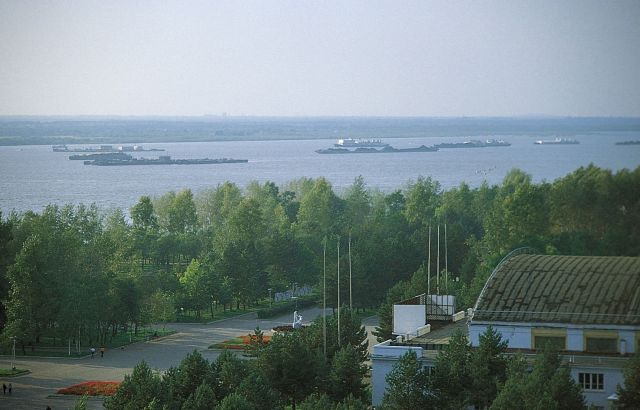
The Amur is a river in the Far East. It passes through Russia (53% of the pool) and China. The main tributaries are: the Zeya, the Ussuri, the Bureya, the Songhua, the Amgun, the Anuy and the Tunguska. Cities: Amursk, Blagoveshchensk, Khabarovsk, Komsomolsk-on-Amur, Nikolaevsk-on-Amur (Russia), Heihe (China).
The origin of the river
The name of the river comes from the word “ amar” of the Manchu-Tungus languages meaning "Big River". The Chinese called Amur "heiho" - " the black river", then "Heilongjiang" - (" the Black Dragon River"). The Mongols called Amur " Khara-Muren" - "black water". Actually the Amur River begins after the confluence of the Shilka - "glen" in Evenki and Argun - "wide" (ergun), translated from Mongolian.
Geographical position
The Amur River Basin is located in the temperate latitudes of East Asia. There are four physiographic zones within the Amur River basin: the forest (with mixed coniferous and deciduous forests, middle and southern taiga), the forest-steppe, the steppe and the semi desert (the northern subzone of the semi-desert and the dry steppe subzone). The annual precipitation ranges from 250-300 mm in most of the arid southwestern part of the basin of the Amur and the origins of up to 750 millimeters in the south-western part of the Sikhote-Alin mountain range. The Amur is formed by the confluence of the Argun and Shilka (as the origin of the river is considered to be the eastern extremity of the island of Mad). In the scientific and popular press there is also the view that the source of the river can take unnamed creek flowing into the Onon river, which merges with the river Ingoda and forms the Shilka River, which merges with the river Argun.
The length of the river
The length of the river is of 2824 kilometers from the confluence of the Argun and Shilka to its confluence with the Amur estuary. Regarding affiliation to the Amur estuary and the Gulf of Sakhalin, therefore, the Sea of Okhotsk, or to the Tatar Strait and, accordingly, the Sea of Japan, the opinions of various authors disagree (TSB refers to the Amur estuary Tatar Strait and the Sea of Japan). TSB indicates that the mouth of the Amur River is considered to be the target of capes and Ozerpah Prong outlet Amur estuary. The specified length references in many of the Amur (4444 ) miles is a geographical myth.
The area of the basin
Taking into consideration the area of the basin (1.855 million km ²) the Amur is the fourth largest river in Russia (after the Yenisei, the Ob and the Lena) and the tenth place among the world's rivers. The average water consumption in the Komsomolsk-on-Amur is of 9819 m ³ / s, near the mouth is of 11 400 m ³ / sec.
The valley of the Amur river
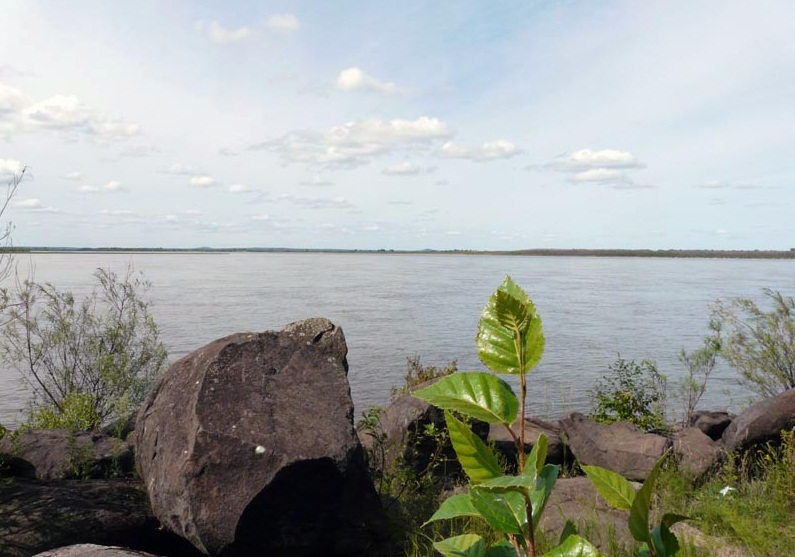
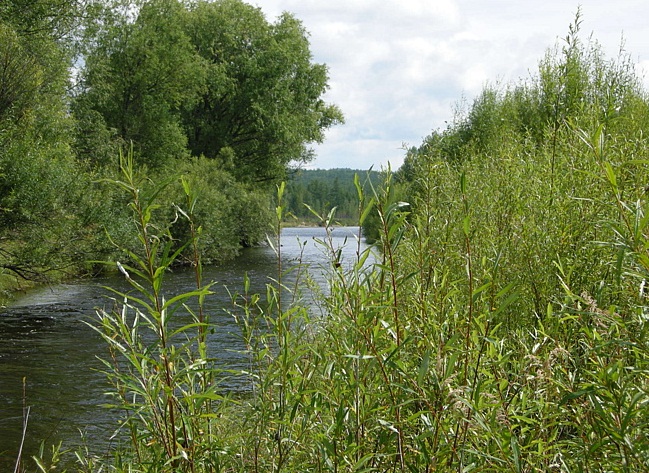
The peculiarities of the valley of the river divide into three main sections: the upper Amur River (the mouth of the river Zeya, 883 kilometers), with a flow rate of 5.3 km / h, the average Amur (from the mouth of the river to the mouth of the Zeya River Ussuri inclusive; 975 kilometers), the flow velocity 5.5 km / h and the lower Amur River (the mouth of the Ussuri River to Nikolaevsk-on-Amur, 966 km),with a flow rate of 4.2 km / h. The valley of the Amur River varies in size throughout its length. In some places, it falls into gorges, it is narrow, then it widens to a few tens of kilometers. The coast is occupied by meadows and forests. The bed of the river changes its direction, and then flood waters rush to the north, then they turn to the south. After the Amur passes back Small Khingan, it forms a large flood plain , and the flow becomes calm. After the confluence of the Ussuri River flow, the water flows more slowly. The most important feature of the hydrological regime of the Amur is the large fluctuations in the water level due almost exclusively to the summer-autumn monsoon rains, which make up 75% of the annual runoff. The level fluctuations in the river is relatively low, the water ranges from 10-15 meters in the upper and the middle and 6-8 in the lower Amur.
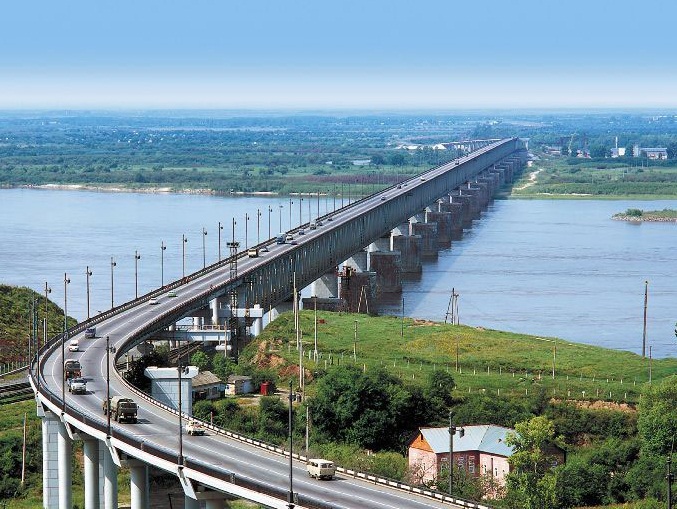
The Amur River basin is located within the three countries - Russia (995 000 km ², about 54% of the territory), China (44.2%) and Mongolia (1.8%). The Russian sector of the basin, in turn, can be divided into two unequal parts - the anthrax, which includes the relevant sections of the river basin Shilka and Argun, and the Far East, within which is essentially the whole valley of the Amur River - the left bank of the upper and the middle Amur River and the entire lower Amur with the relevant parts of this basin as a border. The Amur quickly became shallow in the vicinity of Khabarovsk, with furious ducts located on the opposite bank which got wider and deeper. According to the calculations of hydrologists, every year the stock increases by not less than 3%. In the winter of 2005 Pemzenskaya flow absorbed 51% of the total flow of water in the Amur river, which means that at present it is already the main channel rather than a secondary sleeve. In 2005, the process of shallowing of the Amur near Khabarovsk has slowed somewhat due to the incipient hydraulic works.
Ecology
Almost every year excesses of phenol, nitrate and microbiological elements are recorded in the river. On July 8, 2008 in the Amur region on the Amur River residents have found a spot of unknown origin, presumably oil, which sizes up to 2 km.
The flora and fauna of the Amur River and its basin.
Flora and fauna of the Amur region is quite rich. It is simply an amazing beauty and a diversity of plants and animals. Many of them are listed as endangered. The Amur River basin is characterized by a great diversity of species of flora and fauna. Flowing through a vast territory the Amur combines animals and plants of southern and northern regions. Thickets animals inhabit the north, in the southern forest-steppe zone is inhabited by representatives of the South-East Asia. Here you can meet the American mink, the muskrat, the Far Eastern turtle, the elk, the deer, the tiger, the Amur forest cat, brown and black bears, as well as the sable and the red fox. There are birds like the capercaillie, the hazel grouse, the black grouse, the Siberian spruce grouse, the duck, the mandarin duck, the pheasant Manchurian and the goose-Sukhonos. Some are listed as endangered and preserved only in the Far East. In general, the basin of the Amur river teems with over 70 representatives of mammals, nearly 400 different species of birds, rising more than 5,000 species of vascular plants. This area plays an important role in maintaining the populations of birds such as the Far Eastern white stork, 95% of which nest in the Amur basin. 50% of the population Daurian cranes and 65% of Japanese have chosen the area for reproduction.
Of special value for the river are the chum and the pink salmon, which spawns during the climb into the Amur. Of less valuable, common species are: the crucian carp, the silver carp, the skygazer, the Amur catfish, the Amur pike and carp. In total, the Amur waters are inhabited by about 100 species of fish, making the river one of the richest fish rivers.
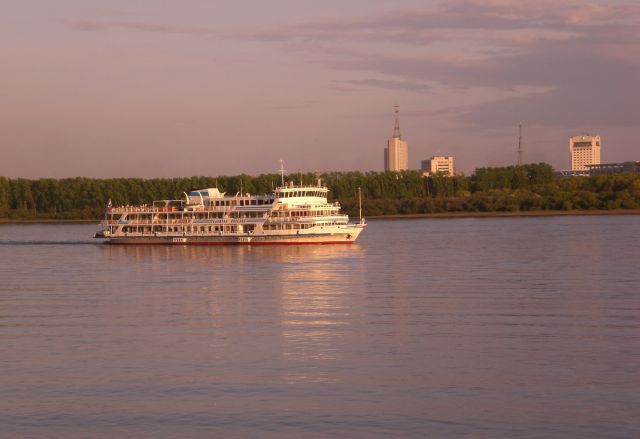
Fishing in the Amur is just incredible. It is a heaven for fishing. So, if fishing is your hobby, you may try it while a cruise on the river. You will experience wonderful moments having the best feelings and emotions. The river has many cozy corners for a perfect holiday, amazing beauty of the nature and a large number of fish provide all the conditions.
Others The Longest Rivers in the World .
Others from The Longest Rivers in the World
Everyone dreams to visit at least one of these places.
Those who live in modern cities with tall buildings tend to lose what Mother Nature has to offer.
They say "beauty is in the eye of the beholder," and there are probably many places that you consider to be most important in the world.
To our mind, rivers are very important and they offer splendid, natural views that Mother Nature offers.
Water is one of the most precious natural resources , we cannot live without it.
Globally, water supplies are rare: less than 1% of the world's water is good for consumption, and much of it, 2/3 of the Earth’s surface is covered by rivers and salt waters.
A river is formed from the union of several streams which naturally flow downhill , under the effect of gravity , which either flows into another stream or river ( its tributary ) or in a lake , a sea or an ocean .
For this reason we do not pretend that our list of places included are the most beautiful, but rather among the vast collection of the longest and the largest rivers in the world.
1 - Nile - 6600 km, the most beautiful areas of the basin downstream waterways are in Aswan.
2 - Amazon - 6480 km, the largest river basin in the world, cruises are up to Iquitos.
3 - Yang Tse Kiang - 6300 km downstream from the dam cruises.
4 - Mississippi - 6280 km, one in four Americans living around the pool's third largest river in the world, every city on its banks proposes at least one cruise.
5 - Yenissei - 5540 km, navigable by small portions, is the longest in Russia.
6 - Huang He (Yellow River) - 5464, with most cruises in China.
7 - Ob Irtchych - 5410 km, one of the 120 rivers that cross Russia.
8 - Congo - 4800 km, the second largest river basin in the world that flows, in sequence with Amazon, African adventure for the brave.
9 - Amur - 4500 km, navigable river, it crosses Russia and China.
10 - Lena - 4400 km, the most eastern of Russian rivers, crosses Siberia from the south to the north and it is one of the most fascinating deltas.
For the lovers of amazing sceneries, these rivers can be the perfect destinations and the cruises the most wonderful experiences.
Cruises have always aroused the curiosity of people even if not everyone can afford such a trip.
If the desire to live new sensations, schedule your vacation early next year and choose a destination that allows you to take a cruise on one of the longest rivers in the world.
Images of The Amur River, icons, photos, figures, visions, appearances, illustrations, snapshots, captures, canvas and pictures of The Amur River - The Longest Rivers in the World